

Two years after Times Higher Education decided to withdraw their Sub-Saharan Africa rankings, QS have decided to step into the breach.
The QS World University Rankings: Sub-Saharan Africa list is based largely on their well-established World University Rankings methodology, rather than being an entirely new exercise. It adds a few metrics (two of which, citations per paper and papers per faculty, are an expansion of their traditional citations per faculty measure), but most of the difference comes from the different weighting of the metrics.
This does result in some changes from the main World University Rankings, and positively there is also a wider range of institutions.
Their initial list contains only 69 universities from 20 countries, and is dominated by South Africa, with nine of the top ten. The final THE Sub-Saharan Africa rankings had 129 universities from 22 countries. This may not seem great in comparison, but the QS World University Rankings only include 18 universities from the same countries, so it is a big step forwards.
QS have been very clear that this is just the start of their focus on Africa, which is also very welcome.
What could help to improve this in future?
- A stronger focus on African issues, for example as articulated through Agenda 2063. This needs to be directly linked to relevant metrics.
- A clear steering hand from a wide range of African people and institutions. This was something that THE worked hard to implement, and there are many challenges for a UK-based organisation working with Africa.
- A long-term commitment. This has to be worked on over a number of years, some of which may not be profitable.
- A plan to support these universities into the main World University Rankings.
On their own terms
I was deeply disappointed when THE withdrew their ranking. It had succeeded in highlighting a different range of African universities, largely by trying to find new measurements with greater relevance.
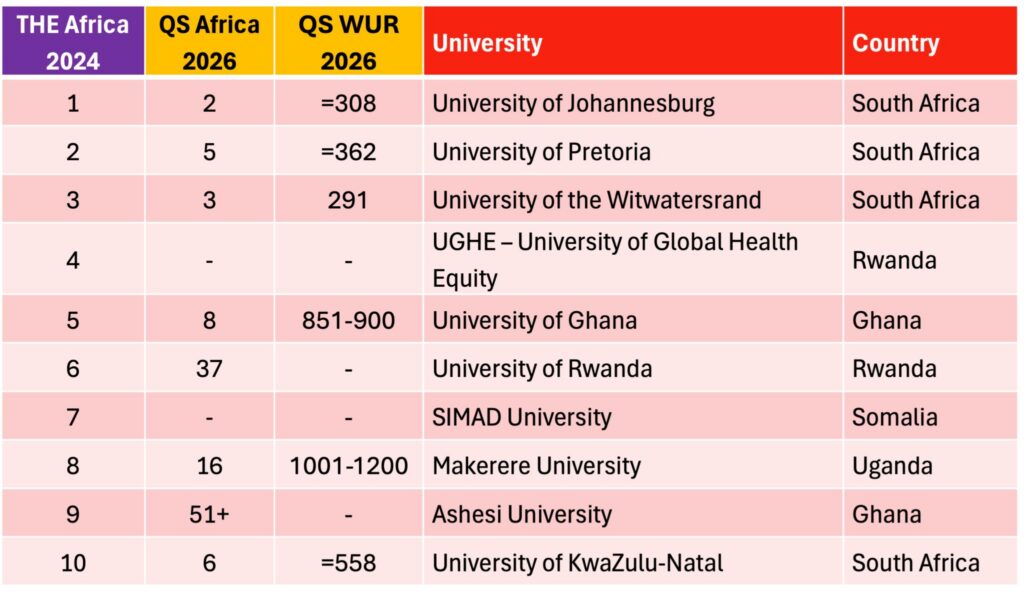
But I think it’s great that one of the big rankings organisations is returning to an Africa focus. Africa, and in particular sub-Saharan Africa, has an incredibly young and dynamic population. African universities deserve visibility and support, but on their own terms.
I would love to hear what friends and colleagues in Africa think of this ranking, positive or negative.
First published on LinkedIn.