

The end of September 2026 saw the launch of the 2027 World University Rankings. Not to be confused with the other 2027 World University Rankings. This one is the Times Higher Education variety.
And we already knew it would be bigger than the 2026 ranking. Phil Baty has announced that more than 3,000 universities have submitted data. But what does that mean?
Submitting data is not the same as being ranked
All of the major rankers differentiate between the universities that are in their dataset and those that are ranked. THE is slightly different from ShanghaiRanking and QS in that it does list them, as Reporter institutions (a change that I introduced).
Countries up and down
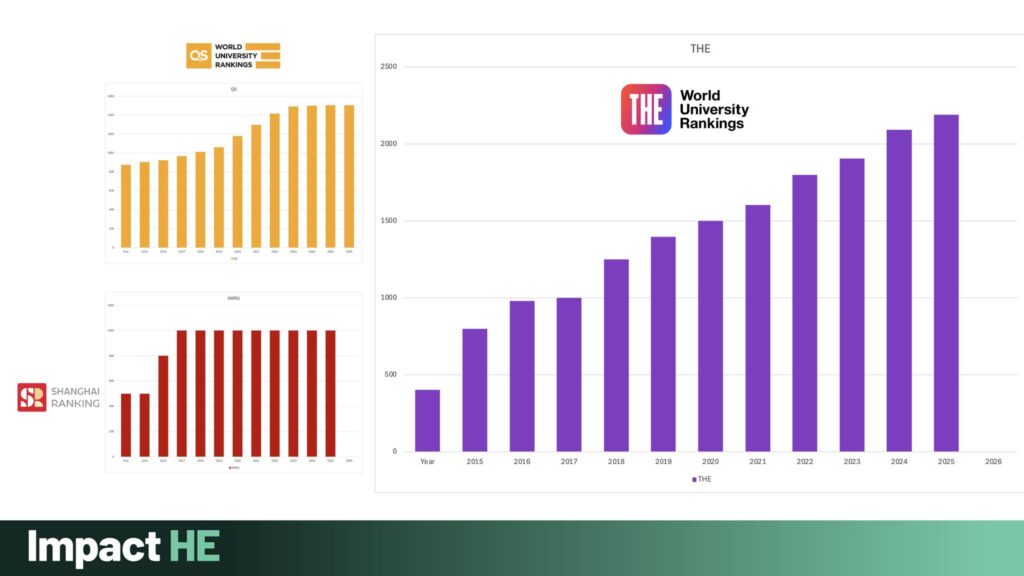
Looking at the charts you can see that all three of the commercial ranking agencies have significantly increased the number of ranked institutions since 2015. THE has seen the biggest rise, and is fairly open that any university that meets its criteria will be ranked. In contrast QS and Shanghai cap their rankings at 1,500 and 1,000 universities.
So what does it mean if a country has more, or fewer, universities participating than in previous years? Is it something to be proud of? Does it indicate a trend?
At an individual institution level, submitting data for ranking is time consuming, and universities need to decide if the cost of participation is worth it. If they are not naturally going to be recruiting significant numbers of international students, this is an important question that they might well want to take advice on.
In or out?
When it comes to universities entering or leaving the rankings, this usually happens lower down the ranks. That isn’t at all surprising: lower ranked universities are less of a concern to the rankers, either reputationally or financially.
If a lower ranked university withdraws it is less likely that they would have purchased the additional products offered by the rankers, and it is highly unlikely that their absence will be noticed on the international stage. This is true even for some larger national institutions such as the Indian IITs, who have been boycotting THE for a number of years. Their absence hasn’t caused a drop in relevance of the THE rankings, nor has it inspired a wave of boycotts across the world.
What does it mean if a country suddenly grows or shrinks its participation? It could mean a shift in the policies of the education ministry. It could mean a shift in the visibility of a ranking in a particular country. Or it could simply be that the rankings agency has employed more salespeople in a region.
So for now, congratulations to the universities and countries that have improved their positions, and commiserations to those who have seen positions slip.
(I predict that the University of Oxford will still be ranked first.)
First published on LinkedIn.